


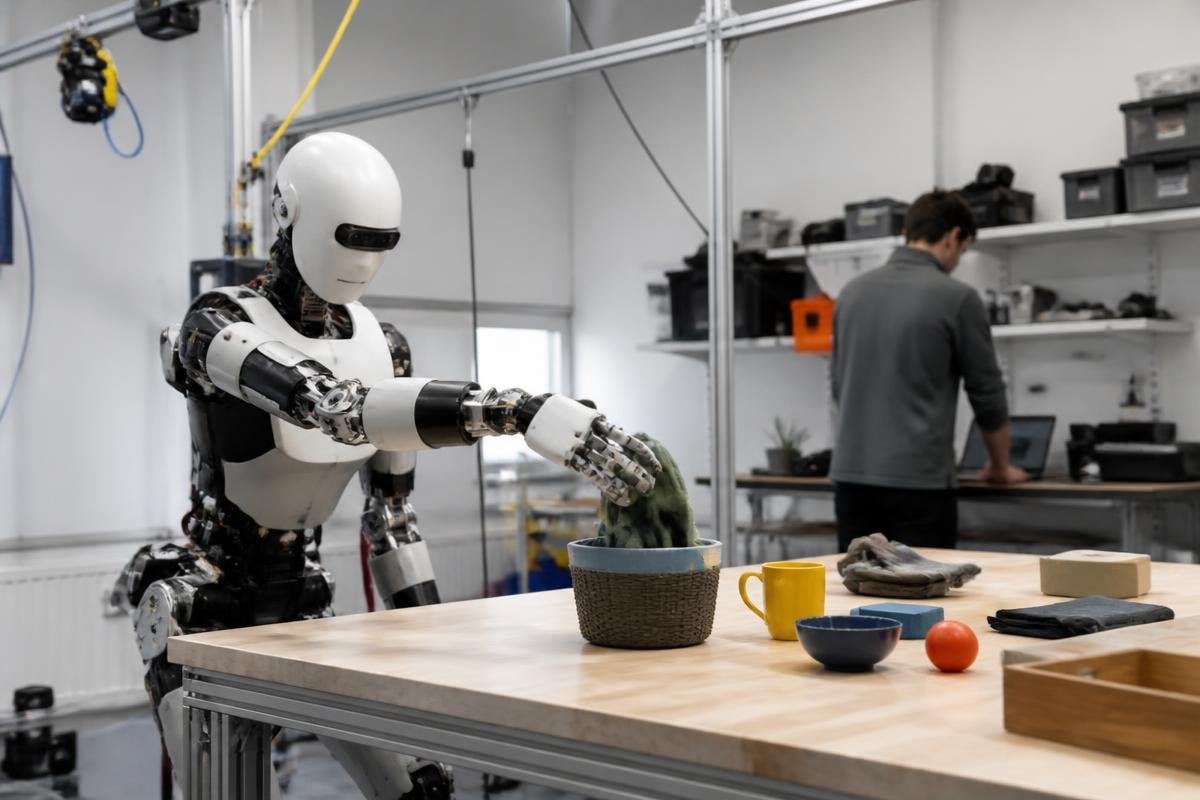
A general-purpose robot has to learn more than one fixed motion. It must connect camera images, touch, joint angles, and motor commands while working around objects and people it hasn’t seen before.
That makes training a long loop of data collection, simulation, hardware tests, and careful failure review. The hard part is teaching the robot what to do when the scene does not match the example.
- Many sensor types: cameras show shape, while force sensors reveal contact.
- Several training stages: software tests come before work on the physical robot.
- A large limit: a successful demonstration does not prove reliable daily work.
Start with useful data
The robot first needs examples that connect a situation to an action. A camera frame might show a cup on a table. Joint encoders report the arm’s position, while motor current gives a rough sign that the gripper is meeting resistance.
Those signals need a shared time reference. If the image is recorded before the arm moves but the joint data arrives after the move, the training example teaches the wrong link between sight and motion. Data teams remove damaged recordings, mark failed actions, and keep the sensor readings tied to each command.
Human demonstrations can supply this data. A person may guide the arm, move a controller, or label the action after it happens. The record must include more than the finished motion. It also needs the starting position, the object being handled, contact with the surface, and the point where the action ends.
That detail matters because a robot can copy a path without understanding why the path worked. A hand that closes around a soft object needs different force from one that lifts a metal part.
Teach the robot in stages
Training usually starts with separate skills. The system may learn to find an object, move an arm, close a gripper, and check whether the object stayed in place. Each skill gives the next part of the system a clear signal to work with.
The robot then needs a policy, which is the software rule that maps sensor input to an action. During training, that policy receives a score for useful results and a lower score when it drops an object, hits a limit, or takes an unsafe path.
Simulation lets a team run many trials without wearing out motors or breaking parts. It can vary object positions, lighting, surface grip, and arm starting points. The gap between a clean simulation and a dusty workshop remains a serious problem, because real cables flex, surfaces slip, and sensors carry noise.
For that reason, physical tests must return to the training set. Engineers compare what the robot expected with what the sensors reported, then adjust the data, the policy, or the control code. A robot that succeeds once has shown a possibility. Repeated success across changed conditions is the stronger test.
Why general tasks are hard
A fixed machine can repeat the same route because its surroundings stay controlled. A general-purpose robot has to choose actions when an object is partly hidden, a person blocks the path, or the item weighs more than expected.
Language adds another problem. An instruction such as “put the tool beside the box” leaves room for questions about which box, how close, and whether the tool may touch the box. The robot needs a way to connect words with visible objects, positions, and safe movements.
Safety also has to sit inside the control loop. Limits on speed, force, joint position, and workspace can stop a command before it causes damage. These limits reduce the range of motion, but they also make testing possible around people and equipment.
Those limits matter beyond a test bench. Robot24.com robotics coverage can place training claims beside reported deployments, so you can check whether a control rule works outside a planned run.
What training has not proved
A polished demonstration can hide the work around it. The video may show a task with known objects, a prepared table, a remote operator, or several failed attempts removed from the final cut. That does not make the result false, but it limits what the result proves.
The open question is repeatability. A training method must handle new objects, changed lighting, small shifts in position, and sensor faults without sending the robot into an unsafe action. Teams also need to measure how often a person must step in and how long recovery takes.
I’d judge a general-purpose robot by its recovery rate and operator workload before its smoothest demonstration. Those figures show whether the system can keep working after the easy case ends.
A practical check before deployment
Use this list when reviewing a training claim or planning a pilot:
- Name the task: state the object, action, workspace, and success rule.
- Check the sensors: record which camera, encoder, or force reading supports each decision.
- Test changed scenes: move objects, alter lighting, and vary the starting pose.
- Count interventions: log every remote command, reset, and human recovery.
- Set safety limits: define speed, force, joint, and workspace limits before trials.
- Review failures: keep the failed runs and add useful cases to the next training set.
A general-purpose robot becomes useful when its training covers the ordinary mess around a task, not only the task itself. The next proof should be a clear record of repeated runs, human interventions, and failures across a changing workspace.
